Customer 360 Is a Margin Project Disguised as a Data Project
Most companies have more customer data than they know what to do with. The ones winning the next decade are not the ones with the biggest databases — they are the ones that turned data into recognition.
The room smelled like stale coffee, dry-erase markers, and mild panic.
It was 4:15 PM on a Tuesday at a mid-market enterprise, and the VP of Marketing was staring at a line graph that looked like a ski slope. Acquisition was up. Conversion was fine. But retention was plummeting out the bottom of the chart.
"We have more data on our customers than any company in our category," the Chief Data Officer insisted, gesturing toward a server rack that cost more than a suburban house. "We track every click, every transaction, every pageview."
The VP leaned back. "Then why did a customer who spent $10,000 with us last year just cancel her account because we sent her a 10% off coupon while she was on hold with support over a broken shipment?"
Silence fell over the glass-walled conference room.
The problem was not a lack of data. They had data in spades. What they did not have was a customer.
The Anatomy of an Institutional Lunatic
To understand how companies lose millions of dollars a quarter to this problem, you have to look at how a business actually sees its customers.
To the e-commerce platform, a customer is a user ID and a cart value. To the CRM, a lead status and a rep's quota target. To the call center — sitting three states away under flickering fluorescent lights — a ticket number with an average handle time hanging over the agent's head.
None of these systems talk to each other. They operate like six strangers trapped in an elevator, each shouting over the other in a different language.
When Jane, a loyal customer, had her package delayed, she called support. To the support agent, she was Ticket #4567 — an angry voice on a headset. She hung up frustrated.
An hour later, the marketing automation tool — completely oblivious to the support ticket — detected that Jane had recently visited the website. It automatically fired off a bright, cheerful email:
"Hey Jane! Loving your new purchase? Check out these matching accessories!"
To the executives, this was an automated workflow working exactly as designed. To Jane, the company did not look like a sophisticated enterprise. It looked like an institutional lunatic with short-term amnesia.
She canceled her account that evening and went to a competitor.
The Trap: Spending More to Fill a Leaky Bucket
For years, the corporate playbook for this problem was simple: spend more money.
When customers quietly slipped out the back door, the answer was not to fix the amnesia — it was to crank up the ad budget. Flood inboxes with "personalized" emails that were really just mail-merges with better branding. Put {First_Name} in the subject line and call it an intimate relationship.
Success was measured by email open rates and click-throughs, while the actual value of the business burned in the background. Customer Acquisition Cost (CAC) soared, data latency sat at a sluggish 48 hours, and Net Promoter Scores hit all-time lows.
The company was running on a treadmill — spending millions of dollars just to replace the people it had alienated the week before.
The Turning Point: Remembering the "No"
The breakthrough did not come from a multi-million-dollar AI pitch or a massive overhaul of the IT stack. It came from a single, radical question raised during a quarterly review:
"What if our systems just remembered when a customer said 'no'?"
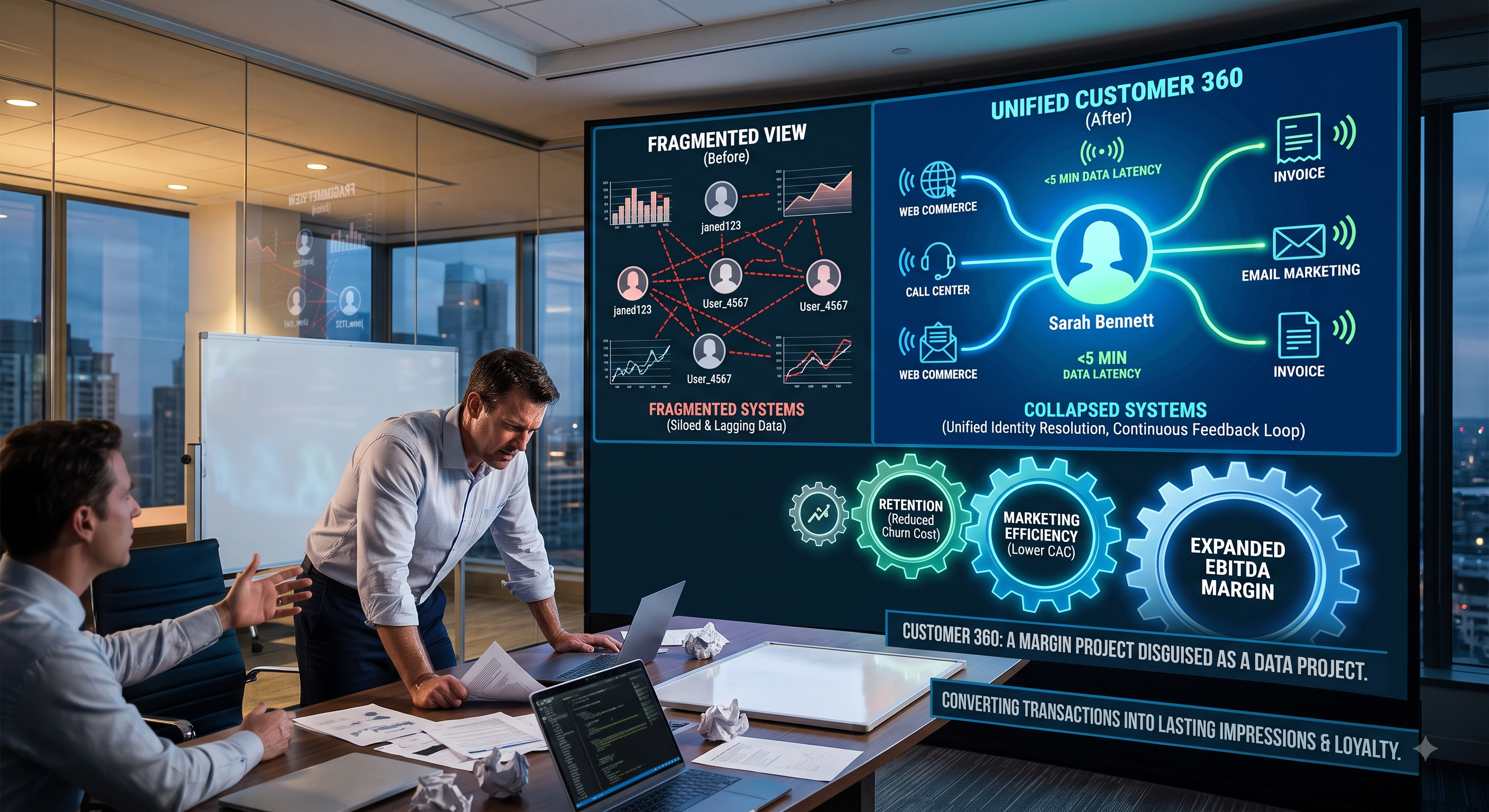
The idea was simple: instead of treating Customer 360 as a massive IT infrastructure project, the leadership team started treating it as a margin project disguised as a data project.
They stopped trying to build bigger dashboards and started building a unified, real-time operating layer beneath the business. Three non-negotiable rules drove the initiative:
1. Unified Identity in Real Time
E-commerce, marketing, service, and sales all wrote to the exact same customer profile in under five minutes. No more waiting for nightly batch updates. No more siloed systems making contradictory decisions about the same human being.
2. Behavioral Context Over Transactions
The system did not just track what a customer bought. It tracked what they browsed, what they abandoned, and what they complained about. The difference between a transaction record and a behavioral context is the difference between knowing someone's name and actually knowing them.
3. Persistent Cross-Channel Memory
If a customer called support about a delayed order, the decisioning layer instantly paused all promotional marketing across email, social ads, and web pop-ups. The right hand finally knew what the left hand was doing — and had the discipline to act on it.
The next time a customer called support with an issue, the agent did not ask them to repeat their story for the third time. The full history was right on the screen. The lag between a customer signal and a company response collapsed from days to seconds.
The company stopped shouting at its customers through a megaphone and started having a continuous, intelligent conversation.
The Margin Explosion
Eighteen months after launching the Customer 360 initiative, the finance team — who usually tuned out whenever marketing talked about "brand loyalty" or "customer delight" — was suddenly paying very close attention.
The shift in operational logic had transformed the balance sheet:
| Metric | Result |
|---|---|
| Churn Rate | Dropped 15% — friction vanished, and retention fell straight to the bottom line without a dime in new ad spend |
| Marketing Efficiency | Surged 22% — wasted ad spend plummeted because the company stopped paying ad networks to target people currently arguing with customer service |
| Service Resolution Time | Cut 25% — agents armed with complete customer context handled calls faster and resolved issues on the first try |
| Net Revenue Retention (NRR) | Rose to 114% — cross-sell and upsell offers were surfaced at the exact right moment in the customer's journey |
Altogether, the initiative delivered 220 basis points of EBITDA margin expansion — not by chasing risky new growth, but simply by being coherent with the customers they already had.
The core insight: Customer 360 is not a cost center. It is a margin engine. Every dollar of friction you remove from the customer experience is a dollar that does not have to be replaced by acquisition spend.
What This Means for Your Business
Every industry is currently crowded with companies hoarding terabytes of customer data. But the companies winning the next decade will not be the ones with the biggest databases.
They will be the ones that turn data into recognition — the simple, powerful feeling of a customer being known, understood, and respected rather than marketed to.
The path forward requires three operational shifts:
1. Treat data latency as a revenue problem, not an IT problem. A 48-hour lag between a customer event and a company response is not a technical inconvenience. It is a structural guarantee that you will say the wrong thing at the wrong time, at scale.
2. Measure the cost of incoherence. Most companies track CAC and LTV in isolation. Few calculate the revenue destroyed each quarter by systems that contradict each other. Build that number. It will be larger than you expect, and it will immediately reframe Customer 360 as a CFO-level priority.
3. Start with the "no." You do not need a perfect unified data platform on day one. You need one rule enforced in real time: when a customer signals distress, every promotional system pauses. That single change, implemented well, will deliver measurable margin improvement within a quarter.
Customer 360 is not just software. It is the bridge that transforms single, forgettable transactions into lasting impressions — and turns basic customer service into compounding profit.
The companies that build this bridge will not just retain more customers. They will build a structural cost advantage that compounds every year their competitors keep running on the treadmill.
humAIne helps enterprise leaders design and deploy Customer 360 architectures that deliver measurable margin impact — not just better dashboards. Let's talk.
Explore Topics
Written by
Suman | humAIne
Content creator and writer sharing insights and stories.