The New Chess Game: Why Marketing Must Stop Waiting
The website-as-destination model is dying. AI agents now synthesize answers and execute transactions without ever visiting your homepage. Here is what to do about it.
For thirty years, modern marketing has relied on a single, unchallenged playbook: build a destination, drive traffic to it, and convert what arrives.
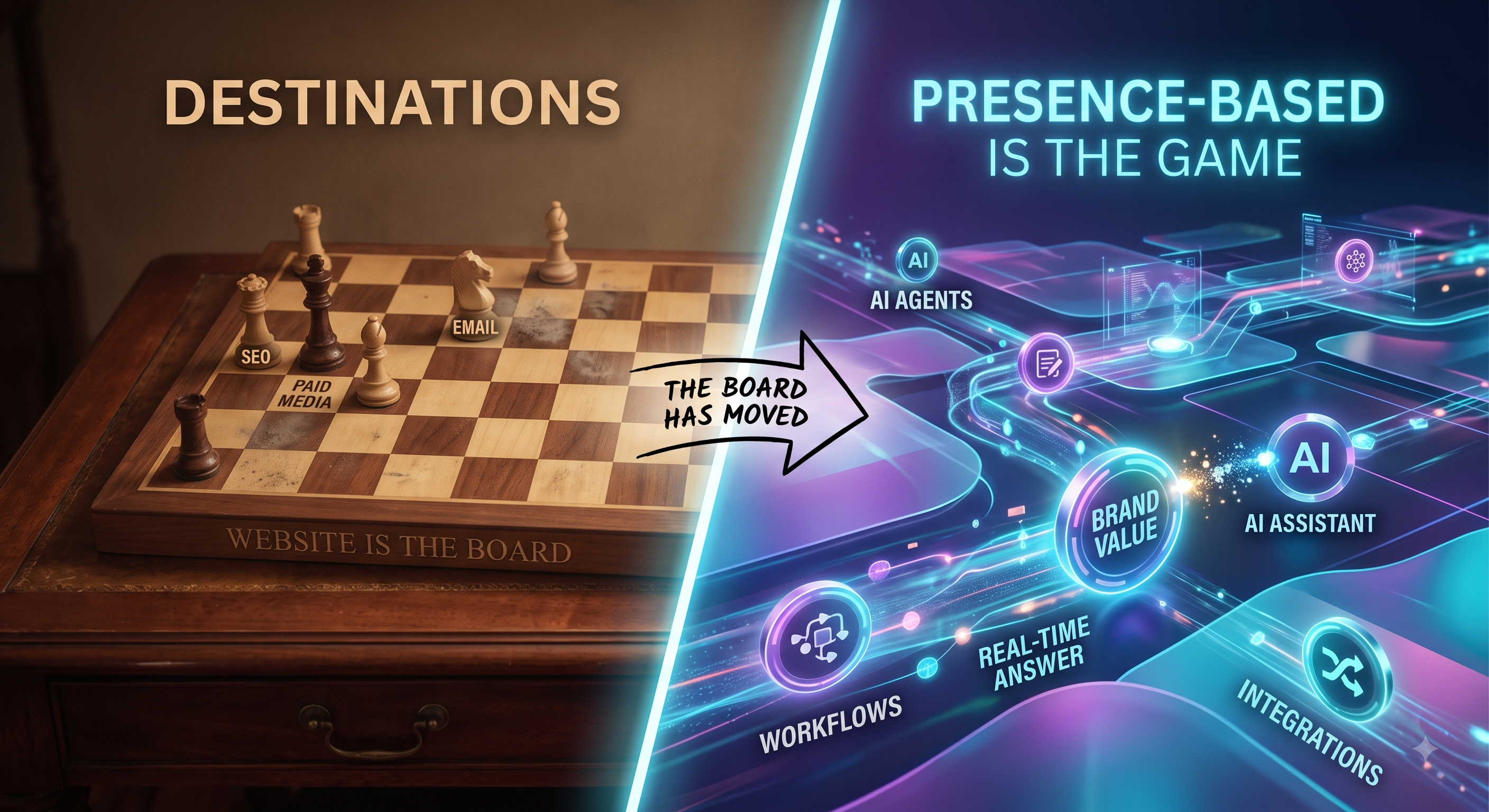
The website was the chessboard. SEO, paid ads, cold emails, and social campaigns were the pieces used to force attention back toward a domain you owned.
That model is dying. Not slowly. Right now.
1. The Board Has Moved
Customers no longer travel across the web to research options and weigh decisions.
Instead, they query an AI agent, receive a synthesized answer, and execute a transaction — all without ever setting foot on a company's homepage.
- Search is being replaced by synthesis.
- Browsing is being replaced by delegation.
This isn't a minor channel shift like moving budget from Facebook to TikTok. It's a location shift.
The moment of decision has migrated away from owned destinations to surfaces marketing doesn't control: AI assistants, embedded enterprise workflows, API marketplaces, and ambient interfaces.
The Hard Truth: If the decision happens somewhere else, showing up there isn't optional. It's the only game on the board.
2. From Destination to Presence
The old playbook demanded: "Bring them to us."
The new imperative demands: "Be wherever they already are, and deliver instant value the second they need it."
This requires an immediate operational evolution:
| The Old Playbook (Destination) | The New Playbook (Presence) |
|---|---|
| Gated Content: Locking value behind forms and homepages. | Portable Value: Structuring data so it can be read and used by external machines. |
| Scheduled Campaigns: Shouting the loudest message on a calendar. | Contextual Answers: Resolving a problem inside a user's workflow at the exact moment of need. |
| Web Traffic Metrics: Measuring vanity clicks and page views. | Presence Metrics: Tracking whether your brand is correctly recommended when an agent asks a question. |
3. Don't Just Beat the Competition — Eliminate It
In the old model, brands fought for preference via comparison pages and feature checklists. But today, product features are matched by competitors in a single sprint.
The only durable advantage left isn't a better feature set — it's zero friction.
When your brand's value is natively embedded into the customer's active workspace — where the question, data, and purchase resolve in one place — there is no moment left for a competitor to insert themselves.
The Grandmaster Move: Don't play to win the current comparison. Play to prevent the comparison from ever happening.
4. Technology Is the Centerpiece, Not the Backdrop
You cannot execute a presence-based strategy with better copywriting or a larger ad budget. It requires fundamental technical infrastructure:
1. A Structured Data Layer
AI agents don't consume unstructured fluff. If your product specs, pricing, and answers aren't machine-readable and semantically structured, you don't get selected. Period.
2. Embedded Activation (APIs over Landing Pages)
Presence isn't just about appearing; it's about enabling action. Modern marketing requires robust integration architecture — APIs, webhooks, data pipes — so transactions complete directly inside third-party environments.
3. Real-Time Signal Orchestration
Presence-based marketing reacts to live signal, not a content calendar. This is an AI and data-routing problem, not a creative studio problem.
4. Influence-Based Measurement Models
If a buyer resolves their problem through an AI assistant without visiting your site, traditional web analytics will report a failure. Marketing leaders must implement tracking models built to measure decision influence and resolution, not just click-through rates.
5. The Ultimate Question for Marketing Leaders
Marketing leaders need to stop asking: "How do we drive 20% more traffic to our website this quarter?"
The real question is:
"Where does our customer actually make their decision, and have we built the technical capabilities to be there with real-time value?"
Marketing teams still measuring success by web traffic are optimizing for a chessboard that no longer exists.
The companies that win the next decade will treat technology not as a backstage tool for marketing, but as marketing's primary playing field — and they will build the infrastructure to move across it faster than anyone else.
Ready to rethink your B2B marketing strategy for the AI era? humAIne helps enterprise leaders build the presence-based infrastructure that wins in a world where the board has moved.
Explore Topics
Written by
Suman | humAIne
Content creator and writer sharing insights and stories.