Milk and Oil: Why Most Customer Journey Orchestration Never Actually Blends
Every strategy deck promises a seamless blend of business goals, customer experience, and technology. Then it hits execution — and separates right back into layers. Here is why the seam between your systems is where your customer is standing, and what it actually takes to emulsify it.
Every strategy deck promises milk and water.
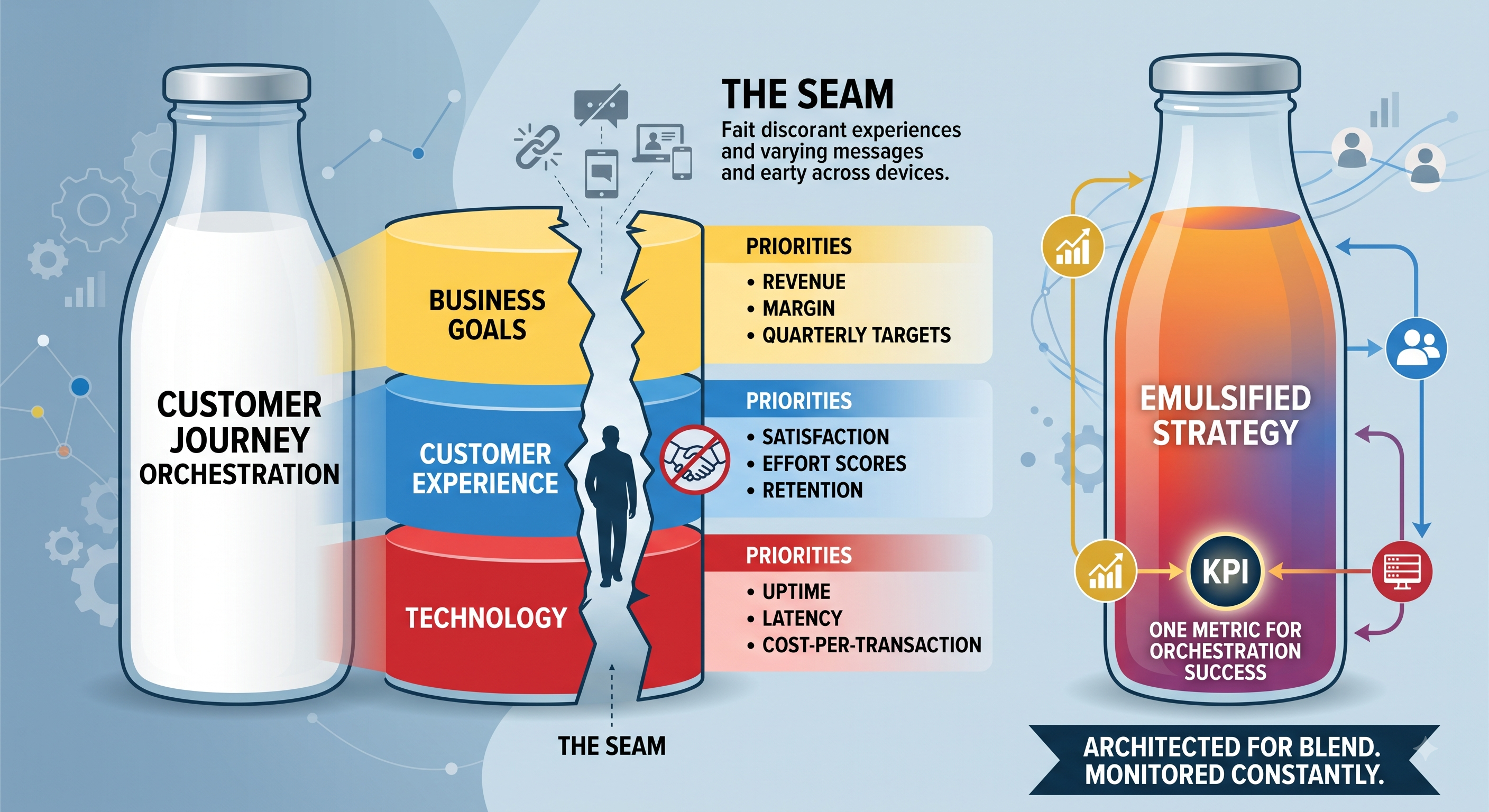
Business goals. Customer experience. Technology. One smooth, homogeneous blend — stir once, never separates again.
Then it hits execution. And what you actually get is milk and oil.
Shake it hard enough — a launch, a QBR, an all-hands — and for a moment it looks blended. Walk away for ten minutes and it separates right back into layers. Because milk and oil were never designed to bond. They just coexist in the same container, waiting for the next shake.
That's most customer journey orchestration today.
Three Systems, Three KPIs, One Customer Stuck in the Middle
Business goals are chasing revenue, margin, quarterly targets.
Customer-centric goals are chasing satisfaction, effort scores, retention.
Technology is chasing uptime, latency, scalability, cost-per-transaction.
Each function optimizes its own layer. Each layer reports green on its own dashboard. Nobody's dashboard measures the seam between them — so nobody owns the seam. And the seam is exactly where the customer is standing.
Marketing promises a seamless, personalized journey. Sales hands off a deal with none of that context attached. The platform enforces a workflow built for scale, not for the moment the customer is actually in. Support inherits a ticket with three different "single sources of truth" and picks whichever one loads fastest.
The customer doesn't experience your org chart. They experience the separation.
Cacophony, Not Conflict
This isn't a case of teams disagreeing. Everyone's aligned on paper. Everyone hit their number.
The cacophony shows up anyway — in the customer's ears, not in the boardroom. A different tone across three channels. A recommendation that ignores what support just resolved. A "customer-first" journey that quietly optimizes for average handle time.
Nobody planned the discord. It's just what you get when milk and oil get poured into the same bottle and called a blend.
Emulsifying It — On Purpose
Real dairy scientists don't wish milk and water into existence when the ingredients are milk and oil. They add an emulsifier — something engineered to bond with both, deliberately, continuously, under agitation.
Customer journey orchestration needs the same discipline:
→ A single KPI that sits across business, customer, and technology — not three KPIs living in three decks, reconciled only in a steering committee readout.
→ An owner accountable for the seam itself, not for one layer of it.
→ Architecture that treats orchestration as the product, not the plumbing underneath someone else's product.
→ Governance that re-checks the blend continuously — because oil and water re-separate the moment you stop watching, and so does your journey the moment a system update, a new campaign, or a reorg jostles the bottle.
The Real Strategic Failure
The plan rarely fails on the whiteboard. It fails in the gap between what was designed and what was integrated — the gap most orgs don't have a KPI for, because no single function is willing to own a metric it doesn't fully control.
That gap is where "customer-centric" quietly becomes a slide, not a system.
If your business, customer, and technology KPIs still live in three separate reviews — you don't have a strategy problem. You have an emulsification problem. And no amount of shaking the bottle harder fixes that.
What's the one metric in your org that actually sits across business, customer, and tech — not just reported by all three?
Explore Topics
Written by
Suman | humAIne
Content creator and writer sharing insights and stories.