The Blend That Automation Can''t Replicate: IQ, EQ, and SQ in B2B Sales & Marketing
Your algorithm knows everything about the buying committee except why they hate each other. Here is why marketing runs on IQ, sales is won on EQ and SQ, and confusing the two is the most expensive mistake in modern revenue strategy.
Why your algorithm knows everything about the buying committee except why they hate each other.
Here is a true thing about human beings: if you place seven of them in a room with a leather conference table, a cold tray of catering sandwiches, and forty million dollars of corporate budget, they will not behave like an algorithm.
They will behave like a family at Thanksgiving.
There is a man in the corner who desperately needs this deal to go through because his daughter's college tuition is due in September and he believes a promotion will save him. There is a woman across from him who will vote against the proposal purely because the man proposing it interrupted her in a staff meeting six months ago. And there is a Chief Financial Officer looking at a spreadsheet who was once ruined by an enterprise software deployment back in 2018, though he has never mentioned this to anyone.
This is the buying committee.
Out in the tech sector, smart people wearing custom-fitted fleece vests have spent billions of dollars building software designed to model this room. They call it Predictive Intent Data. They call it Propensity Scoring. They build elaborate digital pipes that feed dynamic whitepapers into these people's inboxes at precisely three o'clock on a Tuesday afternoon.
And for a long time, the software people believed they were about to eliminate the middleman. They believed that if you gathered enough data points, you could turn the closing of a deal into an automated science — like launching a rocket or predicting the tide.
They were half right. And being half right in business is usually the most expensive mistake you can make.
The IQ Engine
To understand where the software works — and where it hits a brick wall — you have to break human intelligence into three separate buckets, the way a butcher divides a pig.
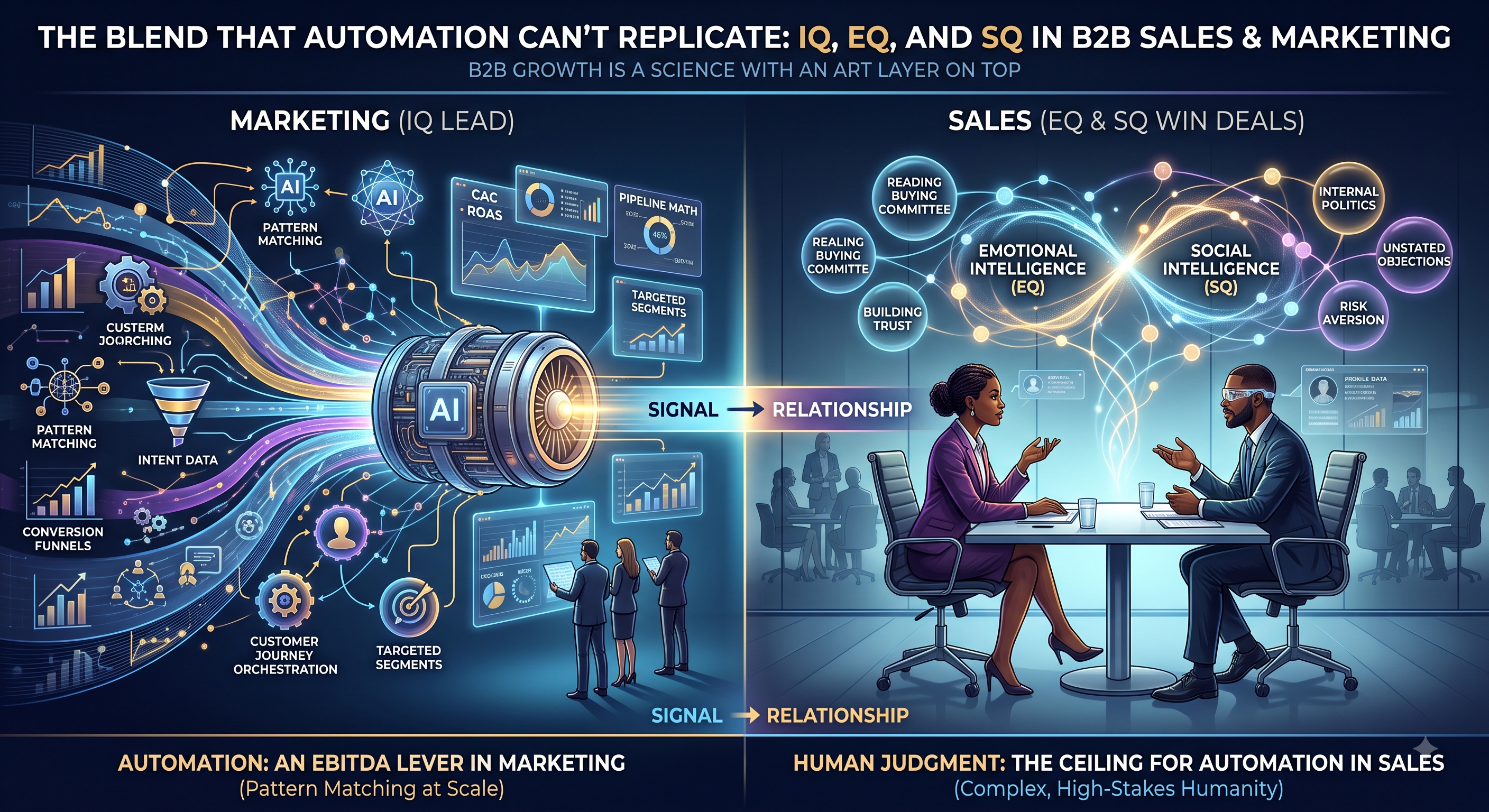
First, there is IQ, or Cognitive Intelligence. This is pattern recognition. It is logic. It is looking at ten thousand internet users, noticing that forty of them read articles about cloud migration on Thursday night, and deciding those forty people might want to buy a database.
This is the natural domain of the machine.
Marketing, it turns out, is mostly IQ. It operates at scale across thousands of strangers you will never buy a beer for. You feed the machine intent data, and the machine spits out a sharper signal. It tells you where the leaks are in your funnel. It drops your Customer Acquisition Cost. It operates like a very fast, very obedient engine room.
When you automate marketing, efficiency goes up. The machine compounds. Everyone gets a bonus, and the CFO buys a slightly larger boat.
The Wall
Then comes the moment the signal hits a live human being. This is where the machine stops working, and where the trouble starts.
Sales does not run on IQ. Sales uses IQ as a foundation, but it is won or lost on two entirely different forms of intelligence: EQ (Emotional Intelligence) and SQ (Social Intelligence).
- EQ is the ability to hear a buyer say, "We need to think about this," and immediately understand that what they actually mean is, "I don't have the authority to sign this check, but I'm too embarrassed to tell you."
- SQ is the ability to walk into that room with the cold sandwiches, look at the seven people sitting around the table, and figure out who actually holds the power, who is protecting their territory, and who is quietly trying to sink the ship.
A computer can map an organizational chart. It can show you that Sarah reports to David, who reports to Susan. But the computer cannot tell you that David secretly despises Susan, or that Sarah is planning to take David's job before the fiscal year ends.
That is Social Intelligence. It is an ancient, primates-around-the-campfire skill.
The Great Misunderstanding
The fundamental tragedy of modern sales enablement is that revenue leaders keep confusing preparation with execution.
They buy an expensive AI tool, hand it to a twenty-four-year-old sales representative, and say: "Look! The robot wrote your pitch deck, summarized their SEC filings, and calculated their propensity score! Go close the deal!"
The young sales representative then sits down with the CFO.
The CFO looks at the proposal and says, "Your price is too high."
The algorithm told the rep to offer a 10% discount. But the rep's EQ — if they have built any — is supposed to notice the small, fraction-of-a-second twitch in the CFO's posture. The price isn't too high. The CFO is terrified of looking foolish in front of his board if the deployment lags.
The discount won't save the deal. Reassurance will. Trust will. A human being looking another human being in the eye and taking responsibility for the risk will.
You cannot automate the moment of trust. Trust is not a broadcast signal; it is a bilateral exchange between two fragile egos trying to navigate internal politics without getting fired.
The Map of the Territory
If you look at the journey of a modern B2B deal, a clear pattern emerges — a line drawn straight down the middle of the room:
| Stage | What the Machine Does (IQ) | What the Human Must Do (EQ / SQ) |
|---|---|---|
| Demand Gen | Targets accounts, scores intent, orchestrates content. | Drafts the core narrative and positioning. |
| Discovery | Maps fit models and surfaces relevant case studies. | Uncovers the unstated pain; reads what isn't being said. |
| Committee Navigation | Maps the formal org chart. | Reads power, unspoken alliances, and ego risks. |
| Negotiation | Sets pricing guardrails and deal math. | Manages emotional tension; protects relationship equity. |
The machine dominates the front half, where the job is to find and inform.
The humans dominate the back half, where the job is to decide and commit.
So It Goes
The next decade will produce two kinds of business leaders, and it will be very easy to tell them apart by their profit margins.
The first group will attempt to replace human judgment with bigger models and faster automated workflows. They will over-automate their sales force, flood executives' inboxes with synthetic, highly personalized nonsense, and wonder why their win rates on enterprise deals keep sliding into the ocean.
The second group will understand the boundary.
They will use automation relentlessly in marketing to multiply their reach, cut their spend, and sharpen their signal. But when that signal reaches a human being, they will hand the baton to skilled reps who have been freed from paperwork specifically so they can spend their time reading rooms, sensing politics, and building trust.
Marketing is a science with an art layer on top. Sales is a human drama that occasionally uses data to keep score.
Know where the machine ends, and let the humans do the heavy lifting.
Explore Topics
Written by
Suman | humAIne
Content creator and writer sharing insights and stories.