From Inside-Out to Outside-In: Why MDM Is the Real Bottleneck in Your AI Strategy
Most AI strategies fail quietly — not because the models are weak, but because the data architecture underneath them was built to run the business, not to understand the customer. The culprit is MDM, and the direction it points determines whether your AI investment compounds or stalls.
Most AI strategies fail quietly. Not because the models are weak, but because the data architecture underneath them was built to run the business, not to understand the customer.
That architecture has a name: Master Data Management, or MDM. And the direction it points — inside-out or outside-in — determines whether your AI investment compounds or stalls.
The Inside-Out Default
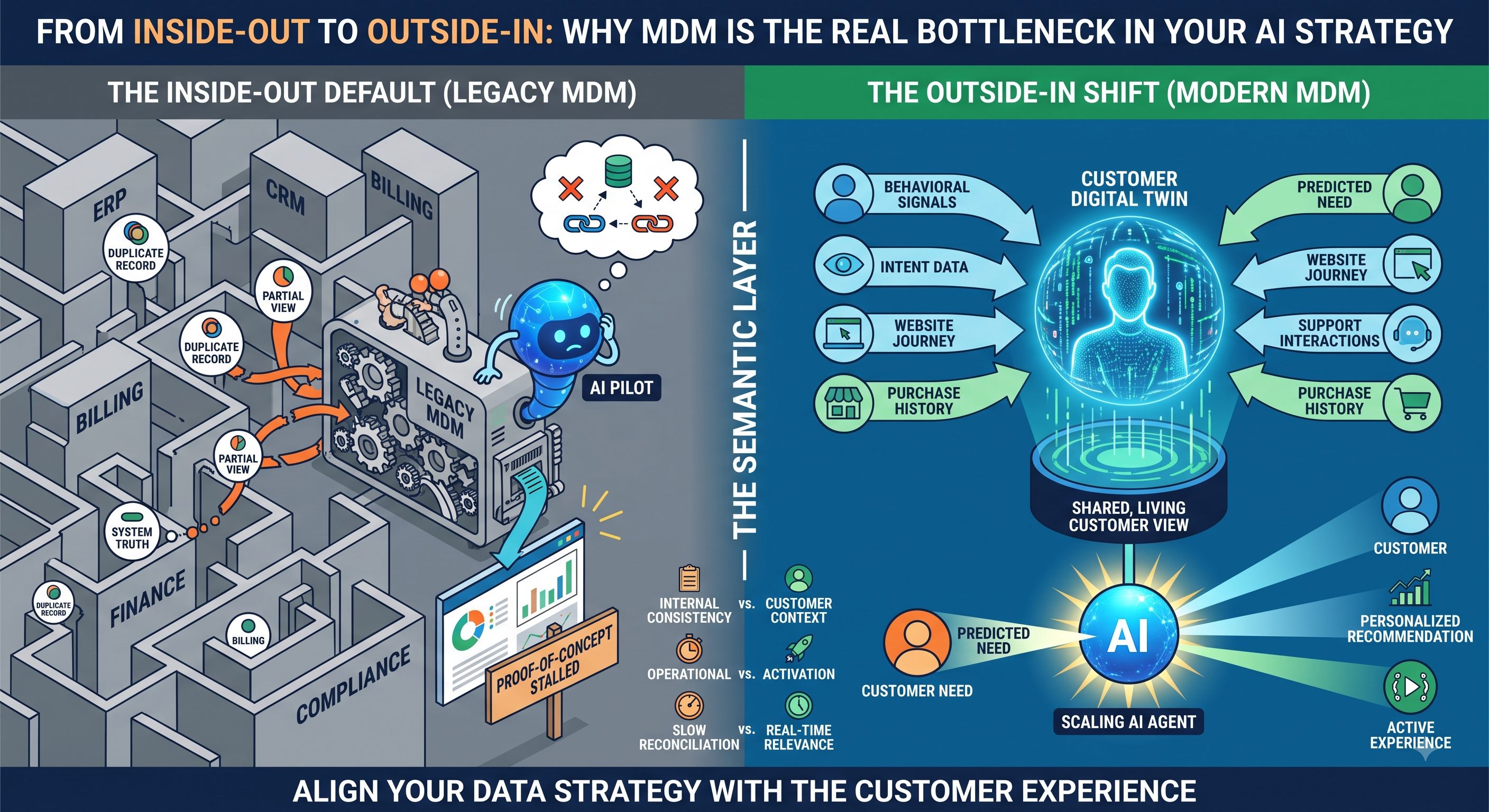
Legacy MDM was built for a legitimate reason: operational control. Match the customer record across ERP, billing, and CRM. Deduplicate the account. Enforce one version of the truth for finance and compliance.
That version of the truth is internal. It answers "who is this account, for our systems" — not "what does this customer need, right now, in this moment." The golden record is optimized for reconciliation, not relevance.
This is why so many AI pilots stall at the proof-of-concept stage. A model trained or prompted against inside-out data inherits its orientation. It gets faster at internal tasks — matching, deduping, routing — but it doesn't get smarter about the customer, because the customer was never the organizing principle of the data model to begin with.
The Outside-In Shift
Outside-in MDM inverts the question. Instead of "how do we structure data so our systems agree with each other," it asks "how do we structure data so it reflects how the customer actually experiences us."
That's a different data model entirely. It means:
- The customer entity spans systems, not owns one. Marketing, sales, service, and finance don't each get their own version of the customer — they resolve to a shared, living representation of them.
- Behavioral and intent signals sit alongside transactional ones. What a customer does, asks, and needs matters as much as what they bought.
- The data model is built for activation, not just reporting. It's designed to feed decisions and experiences in near real time, not just populate a dashboard at month-end.
I've built this as a "Customer Digital Twin" — a layer that sits above the core data warehouse and CRM, giving every downstream system and AI agent one coherent, current view of the customer to act on, instead of each pulling its own partial slice.
Why This Is the Actual AI Scaling Problem
AI doesn't struggle with intelligence. It struggles with grounding. A model is only as customer-aware as the data contract beneath it.
Infrastructure built for internal success optimizes for things like system uptime, record accuracy, and process throughput. Those are necessary, but none of them are the customer's experience. When AI is layered on top of that infrastructure, it inherits the same blind spot: it gets very good at helping the business run itself, and stays mediocre at anticipating what the customer actually wants next.
Outside-in infrastructure flips the incentive. The semantic layer — the contract between the data graph and any AI agent sitting on top of it — is defined in terms of customer context, not system-of-record convenience. That's what lets an AI system scale: not more compute, but a data foundation that was already organized around the thing you're trying to get smarter about.
The Strategic Payoff
A hawk-eyed focus on customer experience does three things to a brand's positioning, simultaneously:
It changes what "differentiated" means. When competitors are all shipping similar AI features, the differentiator stops being the model and becomes the context the model has access to. Outside-in MDM is what makes your AI's answers feel specific to the customer instead of generic to the category.
It compounds value to the end user instead of extracting it. Inside-out systems tend to ask the customer to adapt to the business — re-enter information, navigate separate portals, repeat context across touchpoints. Outside-in systems absorb that friction internally so the customer never has to carry it. The value shows up as time saved and effort removed, which is the currency customers actually notice.
It collapses the B2B/B2C gap. B2B has historically tolerated more friction than B2C — more forms, more handoffs, more "let me check with someone." That tolerance is gone. Buyers now expect B2B experiences to feel as coherent and low-effort as the best consumer apps they use outside of work. Outside-in MDM is the mechanism that makes this possible: it's what lets a B2B platform resolve "who is this buyer, what have they already told us, what do they need right now" with the same immediacy a consumer app applies to a single user, even when the real entity is a multi-stakeholder account with a dozen contacts and a procurement process behind it.
The Practical Shift
This isn't a rip-and-replace argument. Most organizations don't need to abandon their system-of-record MDM — they need to stop treating it as the ceiling.
The move is architectural: keep the operational golden record for what it's good at, and build a customer-oriented semantic layer above it that AI, marketing, sales, and service all draw from. Treat that layer as the actual product of your data strategy, and treat the underlying systems as its suppliers.
Organizations that make this shift stop asking "how do we get AI to work" and start asking "what does the customer need us to know before they ask for it." That second question is the one that scales — because it's the one the customer is actually asking.
Explore Topics
Written by
Suman | humAIne
Content creator and writer sharing insights and stories.